Farnsworth House: International Style
Carol M. Highsmith, Library of Congress
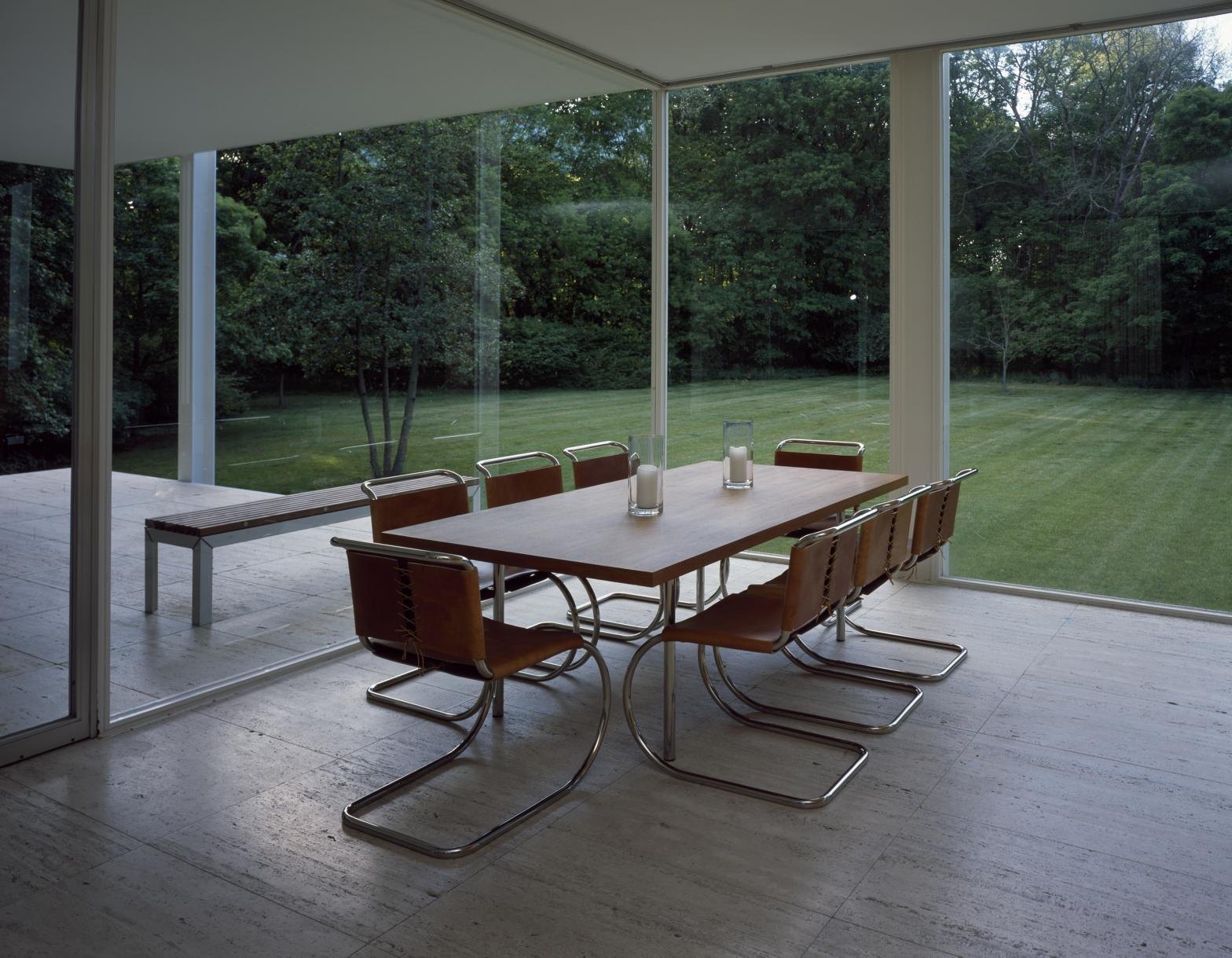
This is a Space reading of a dining area inside a glass-walled pavilion, with a table, chairs and bench set against a wooded lawn. The strongest evidence lives in the building itself: the frameless glass corners, the slim white steel column, the flat ceiling plane and the travertine floor. The building is the Farnsworth House that Mies van der Rohe finished in 1951, and its glass and steel and stone read as the International Style at its height.
Period Record
- Style: International Style
- Expresses 1940s to 1960s (confidence: solid)
- Building by Mies van der Rohe, 1951 (source)
- MR side chair, a 1927 design by Mies van der Rohe (source)
Attributions identify the design only and do not authenticate this example.
The clues, filed under Era Signatures
- Glass corner walls (Form, 1940s to 1960s). Floor-to-ceiling sheets of plate glass meet at the corner with only a thin frame, so the room reads as a single open box. That dissolved corner is a hallmark of mid-century International Style pavilions.
- Slim white steel column (Material, 1940s to 1960s). A narrow painted steel column stands just outside the glass and carries the roof. Exposed, slender structural steel finished in white is typical of International Style building from the 1940s to 1960s.
- Flat floating ceiling (Form, 1940s to 1960s). The ceiling is a smooth, flat white plane that carries on past the glass with no beams or moldings. A thin, level roof slab like this belongs to the International Style.
- Travertine floor grid (Material, 1940s to 1960s). The floor is large rectangular slabs of pale, pitted travertine laid in a tidy grid. Honed natural stone in a modular layout was a favored luxury surface of International Style interiors, and the date of laying stays open.
- Cantilever tube chairs (Form, 1920s). The chairs have bent chromed steel tube frames with no back legs and tan leather seats laced at the back. The cantilever form dates to the late 1920s, so it takes its own design date and leaves the room's counts alone.
Period Palette, 1920s to 1970s
Colors
- Plaster white #F2F1EC
- Steel gray #8A8D8F
- Travertine #CFC6B4
- Glass green #A9C3B5
- Black steel #1E1E1E
Materials
- Plate glass: Large clear panes that turn walls into transparent screens.
- Structural steel: Slim painted columns and frames carrying the whole building.
- Chromed tubular steel: Bent, polished tube used for chairs, tables and lamps.
- Travertine and marble: Honed natural stone for floors and cladding in a clean grid.
Shapes
- Flat roof plane: A thin horizontal slab that hovers over the building.
- Open modular grid: Structure and surfaces set on a regular grid.
- Cantilever curve: Held at one end so furniture seems to float.
Period Study
Searches
- International Style glass pavilion: Find open-plan glass houses of the 1940s and 1950s
- cantilever chrome tube leather dining: Trace the bent-tube chair family through its versions
- 1950s travertine floor modernist interior: See how stone floors anchored International Style rooms
- steel frame plate glass house 1950s: Compare construction of other glass and steel houses
- Bauhaus tubular steel furniture history: Follow the furniture lineage behind these chairs
Icons of the style
- Mies van der Rohe, architect
- Walter Gropius, architect
- Le Corbusier, architect
- Marcel Breuer, furniture designer
- Lilly Reich, interior designer
Where to look
- MoMA Architecture and Design collection: Drawings, models and furniture records for International Style work.
- Library of Congress, Historic American Buildings Survey: Measured drawings and photographs of mid-century American buildings.
- Furniture manufacturer catalogs of the 1950s: Period catalogs show how cantilever chairs and tables were sold and paired.
Lineage
The style grew from early twentieth-century experiments in steel, glass and reinforced concrete, and from a wish to strip a building down to structure and proportion.
Its glass boxes and tubular steel furniture still shape modern houses, offices and the classic dining chair.
Patina reads every image through Era Signatures: Form, Material, Color, Light and Setting. Each clue is filed under one signature, and the style, verdict and dates rest on how many independent clues agree. Readings are made by an AI model looking only at the image you supply, so treat names and dates as a well informed reading rather than an authentication.
Read your own image with Patina