Tiled stair hall: Spanish Colonial Revival with a geometric Moderne influence
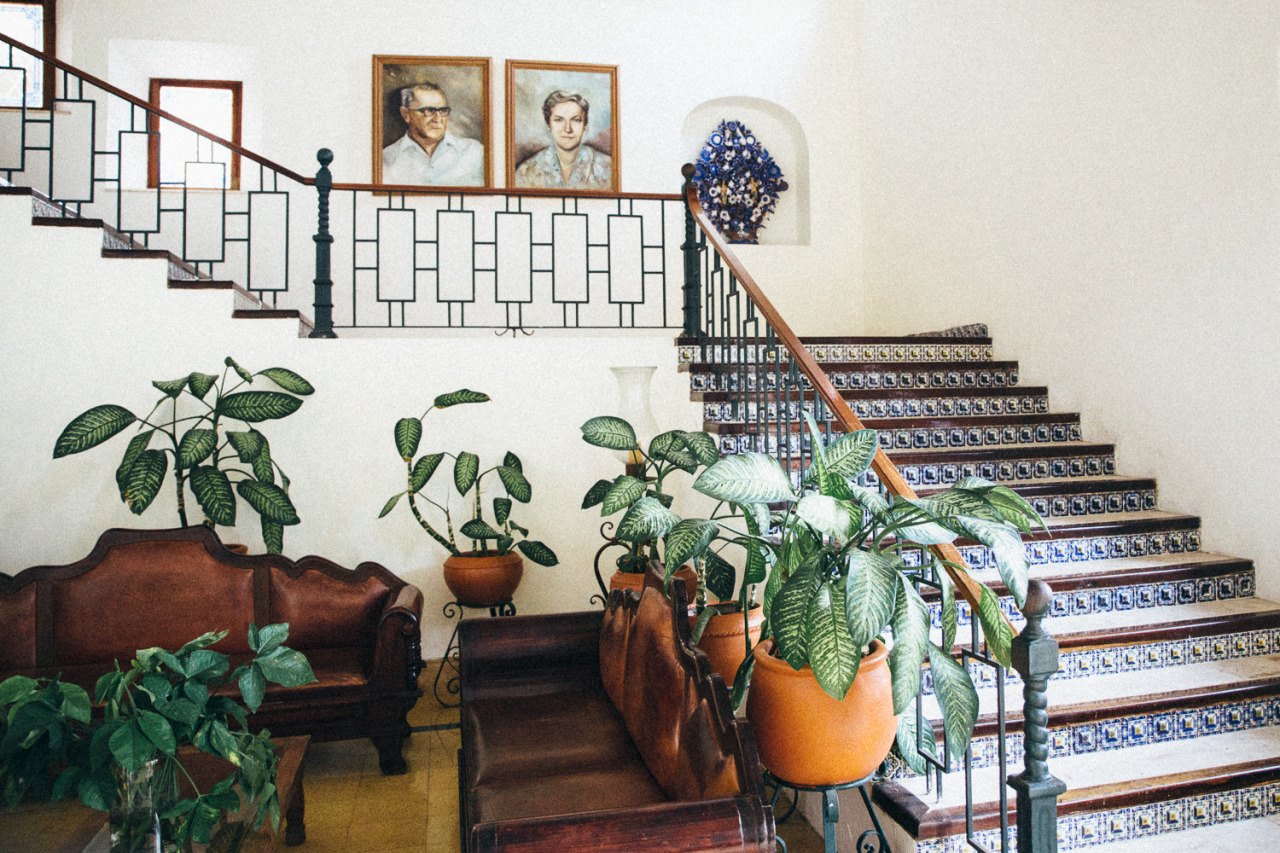
This is a Space reading of a stair hall interior, covering the whole frame. The strongest evidence lives in the stair itself: the tiled risers, the geometric iron railing and the arched niche above. The style and its era are clear, but the building date stays open because the tile, railing and plaster could be original or renewed, and a view of the structure or construction records would settle it.
Period Record
- Style: Spanish Colonial Revival with a geometric Moderne influence
- Expresses 1920s to 1950s (confidence: moderate)
The clues, filed under Era Signatures
- Tiled stair risers (Material, 1920s to 1950s). Each step rise is faced with glazed blue and white patterned tile in the Spanish and Mexican tradition, a surface the Colonial Revival used to give a stair a hand-crafted look.
- Geometric iron railing (Form, 1920s to 1950s). The wrought iron balustrade is built from tall rectangular frames on a regular grid, a rectilinear pattern that adds a Moderne geometry to the Spanish iron tradition.
- Arched wall niche (Form, 1920s to 1950s). A round-arched niche is set into thick plastered white walls, a motif the Colonial Revival borrowed from older Spanish and Latin American houses.
- Carved leather sofa (Form, Movable). The dark wood sofa with a carved crest rail and leather upholstery is a movable piece in a Spanish colonial manner, and it can be dated on its own, apart from the stair hall.
Period Palette, 1915 to 1940s
Colors
- Whitewash #F2EDE0
- Terracotta #C0643A
- Cobalt blue #1F4E9C
- Wrought iron #2B2B2B
- Saffron #E0A83A
Materials
- Lime plaster: Thick, smooth white walls with soft edges
- Glazed ceramic tile: Patterned tile on stairs, floors and fountains
- Wrought iron: Hand-forged railings, grilles and lanterns
- Terracotta: Fired clay roof tiles, floors and pots
Shapes
- Round arch: Arched doors, niches and arcades in thick walls
- Turned post: Lathe-turned wood or iron balusters and newels
- Patterned tile band: Repeating tile borders on steps and walls
Period Study
Searches
- Spanish Colonial Revival stair hall tile: Finds stairways with tiled risers in this style
- Spanish Colonial Revival wrought iron: Shows railing patterns from traditional to geometric
- Mexican neocolonial 1930s interior: Places this room in its Latin American context
- talavera tile stair risers: Helps compare tile patterns and color schemes
- Spanish colonial carved wood leather sofa: Leads to related benches and sofas of this type
Icons of the style
- Bertram Goodhue, architect
- George Washington Smith, architect
- Addison Mizner, architect
- Wallace Neff, architect
Where to look
- Library of Congress HABS collection: Measured drawings and photographs of Spanish Revival interiors and stairs.
- Architecture journals of the 1920s and 1930s: Look for articles on neocolonial houses and hotels in Latin America and the American Southwest.
- Tile makers' pattern catalogues: Period catalogues help compare riser tile patterns and glaze colors.
Lineage
The style looked back to the whitewashed walls, tiled stairs and forged ironwork of Spanish and colonial Latin American houses. It lives on today in courtyard houses, boutique hotels and restored homes that keep its tile, plaster and iron.
The geometric railing shows how later designers adapted the tradition to modern taste.
Patina reads every image through Era Signatures: Form, Material, Color, Light and Setting. Each clue is filed under one signature, and the style, verdict and dates rest on how many independent clues agree. Readings are made by an AI model looking only at the image you supply, so treat names and dates as a well informed reading rather than an authentication.
Read your own image with Patina